
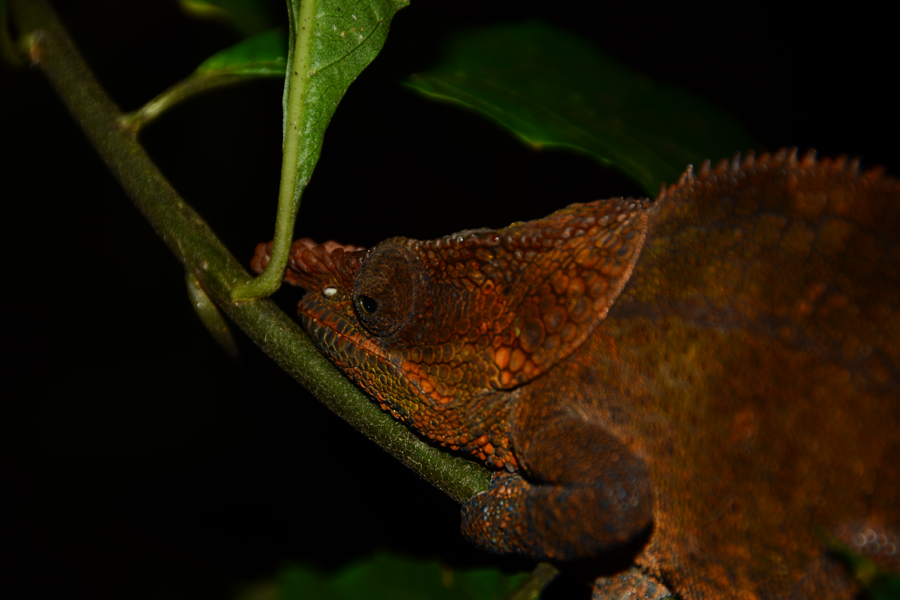
Two-thirds of the world’s chameleons live nowhere but Madagascar. The statistic matters less than what it means for the traveler who knows where to look. These geckos, iguanas and chameleons represent an evolutionary story written in isolation — 165 million years of it.
The island’s reptiles inhabit every ecological niche from rainforest canopy to desert floor. They’ve adapted, specialized, and in some cases, developed abilities that seem borrowed from science fiction. Understanding them changes how you see the landscapes they inhabit.
The Chameleon’s Ancient Mastery
Parson’s chameleons stretch beyond 50 centimeters, their bulk moving through Andasibe’s moss-draped branches with deliberate precision. Watch one hunt and time slows. The tongue strike happens faster than your eye can follow — 20 milliseconds from extension to retraction.
At the opposite extreme, Brookesia micra measures less than 30 millimeters. It perches on matchstick-thin twigs in the Ankarana massif, perfectly camouflaged against bark texture. Finding one requires a guide who thinks in centimeters rather than meters.
The Malagasy believe chameleon eyes see both future and past simultaneously. Local wisdom treats sudden encounters as omens, though whether fortune or misfortune depends on which village elder you ask. The stories matter because they shape how your Malagasy guides approach these creatures — with respect that borders on reverence.
Unicorn chameleons wear their single rostral horn like medieval armor. They inhabit the transition zones between wet and dry forests, territories you’ll cross if you follow the circuits that connect Madagascar’s premier national parks.
Gecko Specialists of the Night Shift
Phelsuma day geckos paint themselves emerald with crimson spots. They work the daylight hours, territorial and visible, patrolling territories measured in square meters of tree trunk. Night belongs to different specialists.
“The Uroplatus fimbriatus becomes the bark it clings to. Until it moves, you’re looking at a tree.”
Leaf-tailed geckos practice deception as art form. Uroplatus phantasticus, the satanic leaf-tailed gecko, disappears against dead foliage. Its tail mimics a decomposing leaf down to the brown spots and curled edges. These creatures inhabit the understory of rainforests where flashlight beams create the only illumination after sunset.
Geckolepis megalepis takes a different approach to survival. Threatened, it sheds not just its tail but entire patches of scales and skin, leaving predators with a mouthful of discarded tissue while the gecko escapes, pink and temporarily naked. The scales regenerate within weeks, leaving no scars.
Where Geckos Reveal Themselves
Night walks in Ankarafantsika reveal gecko diversity impossible to appreciate in daylight. Your headlamp catches eyeshine first — pinpricks of reflected light that disappear when the beam moves away. The technique requires patience and a guide who reads the forest’s nocturnal rhythms.
Daytime gecko watching works differently. Phelsuma species bask on sun-warmed rocks and tree trunks, particularly around flowering plants where nectar supplements their insect diet. They’re quick but predictable, following thermal patterns that experienced guides map by instinct.
Desert Iguanas of the Spiny South
Madagascar’s iguanas — Chalarodon madagascariensis and various Oplurus species — inhabit the island’s arid southwestern regions. These lizards share evolutionary ancestry with South American iguanas, evidence of continental drift written in scales and bone structure.
Oplurus cuvieri, the collared iguana, claims rocky outcrops in the spiny forests near Toliara. Males establish territories atop boulder formations, visible from considerable distances as they bask and display. Their presence indicates healthy dry forest ecosystem — they’re sensitive to habitat degradation.
The landscapes these iguanas inhabit reward travelers who appreciate subtlety over spectacle. Spiny forests appear barren until you understand their adaptations. Every plant conserves moisture. Every animal, including these iguanas, has evolved behavioral patterns that maximize survival in environments where rain falls irregularly.
Timing Your Reptile Encounters
Chameleons move most actively during temperature transitions — early morning and late afternoon. Midday heat sends them into shade where they become nearly impossible to spot. Your guides schedule reptile-focused excursions accordingly.
Gecko activity peaks after sunset but before midnight. Night walks that begin at 7 PM capture peak gecko activity while allowing return to camp before forest temperatures drop and reptile activity decreases.
Desert iguanas follow thermal schedules strictly. They emerge to bask as morning sun warms rock surfaces, retreat during peak heat, then reappear for afternoon basking sessions before nightfall.
The Landscapes That Shape Them
Reptile distribution follows Madagascar’s ecological zones with mathematical precision. Rainforest chameleons differ from spiny forest species not just in appearance but in behavior, diet, and daily rhythms. The transition zones between these habitats often harbor the greatest diversity.
Understanding these patterns helps you plan routes that maximize encounters while respecting the animals’ natural schedules. The expertise matters as much as the equipment. A knowledgeable guide recognizes microhabitats — the specific branch height where certain chameleons hunt, the rock formation that shelters particular gecko species.
After dark, when most visitors retreat to their lodges, Madagascar’s reptiles begin their most active period. Those willing to venture out discover the island’s nocturnal specialists, creatures whose adaptations rival anything found in tropical rainforests worldwide. The commitment to night exploration separates routine wildlife viewing from encounters with species that exist nowhere else on earth.
Private guides who specialize in herpetology — the study of reptiles and amphibians — transform these encounters from chance sightings into systematic education. They read the subtle signs that indicate presence: fresh gecko droppings beneath favorite basking spots, chameleon feeding damage on specific plants, territorial markings that reveal iguana patrol routes.
When planning your Madagascar circuit, factor in dedicated time for reptile observation. These creatures operate on schedules that don’t accommodate rushed itineraries. The patience required becomes part of the reward — slowing down enough to notice the two-centimeter Brookesia or the perfectly camouflaged Uroplatus teaches you to see Madagascar’s landscapes differently.