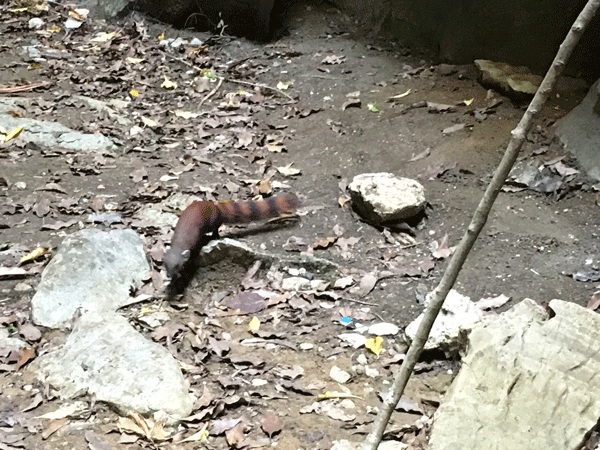
In Madagascar, the greatest wildlife moments are rarely scheduled. They are a flash of red fur across a damp trail, a fleeting glimpse of life lived on its own terms.
Most travelers come to Madagascar for the lemurs. They arrive with a checklist of species, their minds set on the Indri’s call or the Sifaka’s dance. But the island’s real magic often reveals itself in the moments between these marquee sightings. It’s found in the undergrowth, in a sudden, fluid movement of russet and black. This is the world of the Ring-tailed Mongoose, or Vontsira, as it’s known in Malagasy.
Forget the dry, encyclopedic facts. Knowing its exact length or weight won’t heighten the experience of seeing one dart across your path, its striped tail held high. What matters is knowing where to be, when to look, and what its presence signifies about the health of the forest. This is not an animal that performs for an audience. It is a hunter, a survivor, and a vital thread in the island’s intricate ecological tapestry.
Beyond the Checklist: Sighting the Vontsira
To see a Ring-tailed Mongoose is to witness pure, kinetic energy. They are creatures of constant motion, perpetually investigating, foraging, and patrolling their territory. Unlike many of the island’s more cryptic animals, the Vontsira is diurnal, most active during the cooler hours of the morning and late afternoon. The encounter is almost always unexpected: a rustle in the leaf litter, a blur of motion along a stream bank where it hunts for frogs and small crustaceans.
This is where an expert guide becomes indispensable. A good guide doesn’t just walk a trail; they read it. They know the Vontsira’s habits — its preference for water sources, its use of fallen logs as highways through the forest. They will pause not because they’ve seen something, but because the conditions are right for something to be seen. They transform a simple walk into an exercise in observation, teaching you to see the forest as they do: a living environment, full of signs and whispers.
Where to Look: From Rainforest to Dry Forest
While the Ring-tailed Mongoose is one of Madagascar’s more widespread carnivores, your chances of a meaningful encounter depend entirely on where you are. Location dictates not just the likelihood of a sighting, but the entire context of the experience.
The Eastern Rainforests: Ranomafana & Andasibe-Mantadia
In the humid, emerald world of the eastern rainforests, the Vontsira is in its element. Along the trails of Ranomafana National Park, particularly those that follow the Namorona River, sightings are common. Here, its vibrant, reddish coat stands in sharp contrast to the deep greens and damp, dark earth of the forest floor. An itinerary along the RN7 naturally incorporates Ranomafana, pairing the search for this agile carnivore with quests for several species of bamboo lemur and colorful chameleons.
The Western Dry Forests: Kirindy Mitea
The experience in the west is entirely different. In the dry deciduous forests of Kirindy, the light is harsher, the landscape more stark. Here lives a different subspecies, slightly paler to blend with the sandy soil and grey tree trunks. A sighting in Kirindy feels earned. It places the Vontsira in the same landscape as its larger, more formidable cousin, the Fossa. This region is the heartland of Madagascar’s unique Eupleridae family, and an expedition here is often combined with visits to the iconic Avenue of the Baobabs, offering a powerful narrative of the island’s ecological diversity.
“You don’t find the Vontsira. You let the forest show it to you. You just have to learn how to watch.”
A Photographer’s Challenge, A Family’s Delight
The Ring-tailed Mongoose offers a different kind of reward for different travelers. For the wildlife photographer, it is a formidable challenge. Capturing a sharp image of this fast-moving creature in the low, dappled light of the forest canopy requires skill, patience, and a bit of luck. The shot is rarely perfect, but it is always authentic — a true representation of life in the wild.
For families, however, the Vontsira is a source of pure delight. Its daytime activity and relative abundance make it one of the most reliable and engaging sightings for younger travelers. It’s an animal that tells a story — of adaptation, agility, and the unseen life of the forest floor. It provides an accessible entry point into the complexities of Madagascar’s unique fauna, sparking a curiosity that larger, shier animals sometimes cannot. It’s a reminder that on this island, every creature, no matter its size, has a role to play.
BUILDING A JOURNEY AROUND MOMENTS
An itinerary should be measured by its encounters, not just its destinations.