
In the arid southwest of Madagascar, the Mahafaly people have developed a funerary art of such complexity and visual force that their tombs have been studied by anthropologists, sought out by artists, and remembered by every traveler who has stood before one. They are not monuments to death. They are arguments for the continuation of life.
There is a moment, driving through the sparse, thorny landscape of southwestern Madagascar, when the flat horizon gives way to a sudden cluster of color. Wooden posts rise from a granite platform—carved, painted in vivid red, green, yellow, and blue—topped with figurines of zebu, birds, motorcycles, airplanes, and human forms caught in the gestures of daily life. This is a Mahafaly tomb, and nothing in the surrounding landscape fully prepares you for it. The desert is dun-colored and spare. The tomb is an explosion.
A theology made visible
For the Mahafaly, death is not an ending but a threshold—a passage into a form of existence that continues alongside the living, requiring attention, offerings, and the ongoing maintenance of relationships. The tomb is the physical address of that continuing presence: a shrine, a territorial marker, a declaration of family identity, and a work of art, all at once. Its construction is among the most significant investments a Mahafaly family will ever make. The quality of a man’s tomb reflects the respect in which he was held and the seriousness with which his family regards their obligations to him.
The foundation is built in granite—chosen for its permanence, its resistance to the elements, and its refusal to soften over time. Into this foundation is set the platform that will hold the sculptural program above: the carved wooden posts known as aloalo, whose imagery is as specific and intentional as any commissioned artwork in any tradition.
“The Mahafaly do not decorate their tombs. They inscribe them—with the biography of the deceased, the beliefs of the community, and the conviction that what is carved in hardwood and painted in primary colors will outlast the memory of those who made it.”
The visual language of the aloalo
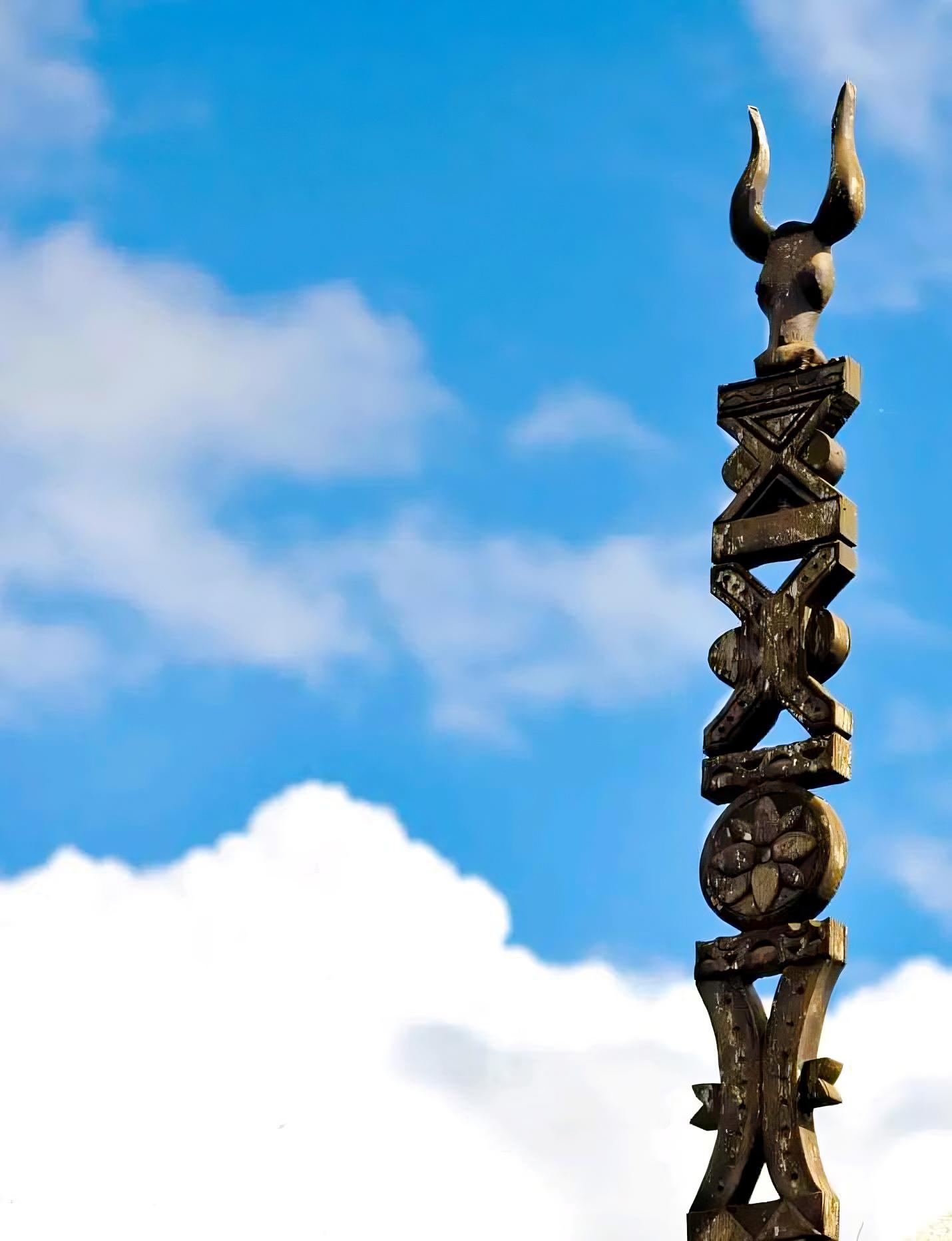
The aloalo posts are the heart of Mahafaly funerary art. Carved from hardwood chosen for its resistance to the harsh southwestern climate, they are painted in colors of deliberate intensity and crowned with figurines that narrate the life of the person buried beneath. A man who owned many zebu will be commemorated with carved zebu. A traveler
may appear with an airplane. A hunter with his prey. The imagery is not symbolic in the abstract sense—it is biographical, specific, and irreplaceable.
Aloalo posts
Carved hardwood columns rising from the granite platform, painted in primary colors and topped with figurines that document the biography of the deceased.
Geometric patterns
Circles, triangles, and checkerboard motifs incised into the stone foundation—a visual grammar shared across the community that speaks of order, continuity, and identity.
Terracotta figurines
Representations of family members and animals were placed within the tomb’s decorative program—the community of the living, made permanent in clay, keeping the deceased company.
Granite foundation
The structural base of every Mahafaly tomb—chosen not for beauty but for endurance. The tomb is built to outlast everything around it, including the memory of its makers.
The ceremony and those who sustain it
The construction of a tomb is accompanied by a ceremony whose scale reflects the importance of the transition being marked. The passage from one life to another is not treated as a private grief—it is a community event, organized and witnessed, with offerings of food, water, valuables, and sacrificial animals presented as pledges of continued relationship between the living and the dead. Zebu are slaughtered. The feast is shared. The deceased is accompanied, with deliberate ceremony, into what comes next.
The ongoing relationship with the tomb does not end with the burial. Designated guardians are responsible for the maintenance of the site—for ensuring that the offerings are made, that the structure remains in good condition, and that the presence of the deceased is acknowledged and respected across generations. The tomb is not visited once and forgotten. It is tended.
Tombs as landscape and as boundary
In the southwest, Mahafaly tombs serve a function that is simultaneously spiritual and territorial. They mark the boundaries of family land, establish the presence of a lineage in a particular place, and assert—in the most durable material available—the claim of a community to its ground. A family’s tombs are its most permanent structures. They outlast the houses of the living. In the long run, the dead hold the land.
Seen from a distance, scattered across the arid plateau in clusters, the tombs read as a second settlement—a community of the dead arranged across the landscape with the same logic as the community of the living nearby. The two populations are understood to coexist. The tombs make that coexistence visible.
Few encounters in Madagascar are as quietly profound as standing before a Mahafaly tomb in good light, reading its carved posts the way you would read a face—looking for what it is trying to tell you about the person it honors and the people who built it. The imagery is specific. The craft is serious. The intention is unmistakable.
“This is a culture that takes death seriously enough to make something beautiful of it. That, in itself, is worth traveling for.“