
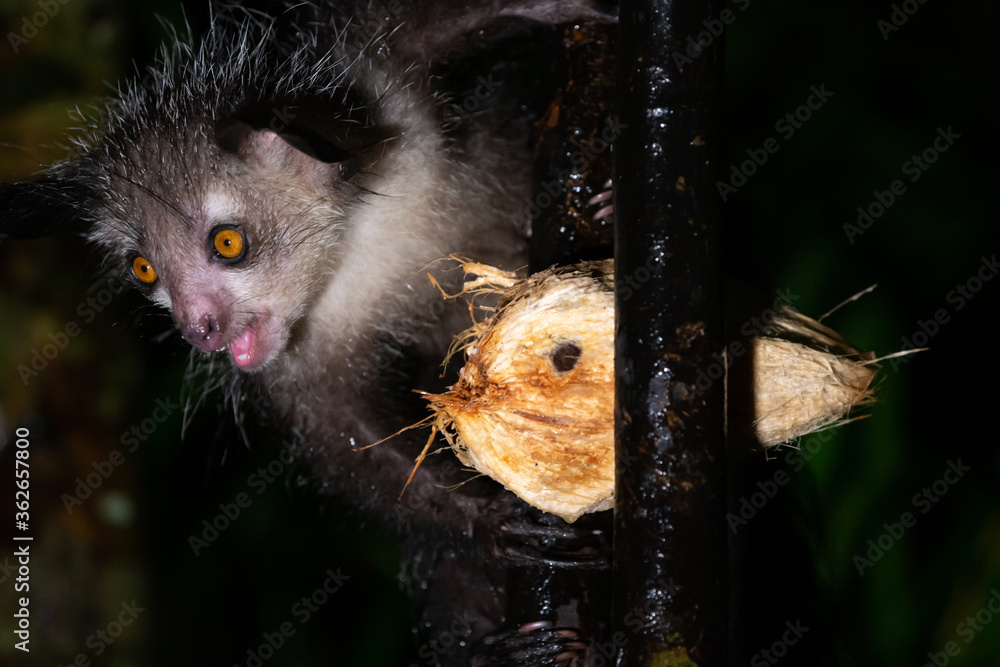
Beyond Madagascar’s dense rainforests lives one of the most unusual primates on Earth: the aye-aye. Rarely seen and often misunderstood, this nocturnal lemur is scarcely a biological curiosity—it is one of evolution’s most singular experiments. Scientifically known as Daubentonia madagascariensis, it is the only surviving member of its family, a lineage distinct from any other among primates.

A Masterpiece of Adaptation
To encounter the aye-aye in its natural habitat is a privilege reserved for the patient observer. Every feature of its anatomy serves a precise function:
The Auditory Architect: Large, sensitive ears that detect the slightest movement deep within the trees.
The Percussionist: An exceptionally long middle finger used for “percussive” foraging—tapping on bark to locate larvae concealed beneath the surface with surgical precision.
The Mythical Aura: Known to locals as a creature of great mystery, its name is whispered in the rainforests, often followed by the expression “He he”—a Malagasy phrase for the unknown.
A Nocturnal Presence
While popular culture has sometimes portrayed this lemur as a sidekick, the reality is far more profound. The aye-aye is a solitary, wise, and pragmatic survivor. Its presence in the ecosystem is vital, yet it remains one of the most endangered species on Earth. To seek the aye-aye is to engage in a conservation journey, witnessing a “living jewel” that few humans will ever see in the wild.

An Exclusive Night Safari
Observing the aye-aye requires expert tracking and access to Madagascar’s most preserved rainforests. It is an experience of silence, shadows, and the thrill of the unexpected—an authentic witness to the island’s untamed wild
All Credit Photo: Masoala Forest Lodge