
Six nocturnal lemur species in one forest—Kirindy holds the highest density of night-active primates anywhere on the island.
Most travelers visit Madagascar’s dry forests during the day and wonder where all the wildlife has gone. The answer reveals itself after sunset, when Kirindy’s true residents emerge from hollow baobab trunks and tangled canopies.
Sixty kilometers north of Morondava, this fragment of western dry deciduous forest operates on a different schedule than the rest of Madagascar. What appears lifeless under the afternoon sun transforms into one of the island’s most active ecosystems once darkness falls. Eight lemur species call this place home, six of them strictly nocturnal.
No other single location in Madagascar concentrates this diversity of night-adapted primates in such a compact area. While Vakôna Private Reserve offers wildlife encounters in controlled settings, Kirindy delivers something rawer—predator and prey dynamics that have evolved over millennia.
The Night Shift
Kirindy’s nocturnal lemurs have divided the forest between them with surgical precision. Lepilemur ruficaudatus—the red-tailed sportive lemur—claims the higher canopy territories. Below them, the tiny Microcebus myoxinus and murinus occupy different microhabitats, rarely crossing paths despite sharing the same trees.
The fork-marked lemur, Phaner furcifer, follows scent trails invisible to human noses, marking territories that stretch across multiple hectares. Its distinctive white facial markings catch headlamp beams like reflective paint. Cheirogaleus medius—the fat-tailed dwarf lemur—emerges only during certain seasons, fattening for months-long periods of torpor.
Mirza coquereli moves through the forest with deliberate stealth, its large eyes scanning for prey and competitors alike. Each species operates within its own temporal window—some active at dusk, others deep into the night, a few waiting until just before dawn.
Daytime Residents:
Two diurnal species anchor Kirindy’s daylight hours. Propithecus verreauxi—Verreaux’s sifaka—moves through the forest in family groups, their distinctive calls echoing across the canopy. Eulemur fulvus rufus browses methodically through the understory, less dramatic but equally specialized for this dry ecosystem.
The Island’s Apex Predator
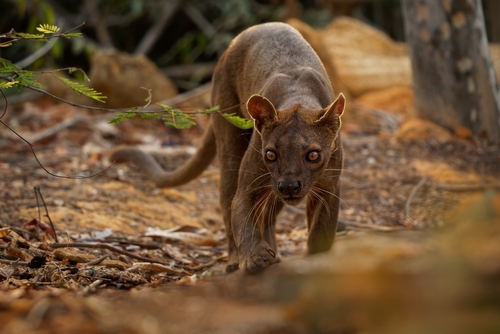
Cryptoprocta ferox—the fossa—hunts Kirindy’s forests with methodical patience. Madagascar’s largest carnivore appears most frequently during the late afternoon transition period, when diurnal lemurs settle into sleeping sites and nocturnal species haven’t yet emerged.
Guides track fossa movements by reading territorial scent marks on specific trees. These markings, refreshed every few days, create a map of the forest’s predator activity. A fresh mark means recent presence—sometimes within hours.
The fossa’s hunting success depends on surprise and stamina rather than speed. It can pursue lemurs through the canopy for extended periods, using semi-retractable claws and exceptional balance to navigate branches that would challenge smaller predators. Unlike the diminutive Brookesia nana chameleon that hunts insects, the fossa targets prey that can weigh several kilograms.
“In Kirindy, the forest doesn’t wake up at sunrise—it goes to sleep.”
Reading the Forest
Experienced guides interpret Kirindy through sound rather than sight. The alarm calls of sleeping lemurs indicate fossa proximity. The rustle of leaves overhead reveals feeding patterns. Even silence carries information—too quiet means a predator has passed recently.
Baobab trees serve as vertical highways and shelter systems. Hollow trunks provide nesting sites for multiple species, while the canopy offers protected travel routes. During Madagascar’s dry season, these ancient trees become water reservoirs, their trunks storing thousands of liters.
The forest’s seasonal rhythms dictate wildlife behavior more than daily temperature fluctuations. Lemur activity peaks during cooler months when insects are less abundant and competition for resources intensifies. Unlike the structured experience of Andasibe-Mantadia National Park, Kirindy offers no guarantees—only possibilities that reveal themselves to patient observers.
Practical Considerations
Night walks require headlamps with red filters to minimize disturbance to nocturnal species. Standard white beams can disorient lemurs and disrupt feeding behavior. Quality walking boots are essential—Kirindy’s terrain includes loose sand, exposed roots, and scattered limestone fragments.
The best wildlife viewing occurs between 6 PM and 10 PM, when most species are actively foraging. Early morning walks from 5 AM to 7 AM capture the transition period as nocturnal species return to shelter and diurnal animals begin their daily routines.
Access to Kirindy requires advance coordination with research station management. The forest operates as a scientific reserve first, tourism site second. This approach maintains the ecosystem’s integrity while limiting visitor impact on ongoing research projects.
Experience Kirindy’s Night Forest
Six nocturnal lemur species await in Madagascar’s most concentrated primate habitat.