
QUICK OVERVIEW
Atsimo-Andrefana is not the Madagascar of popular imagination. Forget the rain-soaked emerald canopies of the east. This is the island’s arid soul, a vast, sun-bleached territory in the deep southwest defined by what it lacks: water. This scarcity has sculpted a landscape of profound and bizarre beauty, an alien tableau of thorny succulents and swollen-trunked trees that constitutes one of the most unique ecosystems on Earth. Centered on the regional capital of Toliara, this is a land of climatic extremes and evolutionary genius, where the ghostly Verreaux’s sifaka leaps through the improbable spiny forest and the semi-nomadic Vezo people ply the turquoise waters of the Mozambique Channel. To travel here is to witness life distilled to its most resilient and inventive forms.
GEOGRAPHICAL IDENTITY
Occupying the southwestern corner of Madagascar, Atsimo-Andrefana exists in the rain shadow of the central highlands. Prevailing easterly winds exhaust their moisture over the eastern escarpment and the central plateau, leaving this western flank parched for most of the year. The region is a low-lying coastal plain rising gently toward the interior, underlain by Tertiary limestone and ancient sand deposits. This geological foundation, combined with relentless sun and minimal rainfall, creates a crucible of aridity. The result is not a classic sand desert, but a singular biome: the spiny forest, or “spiny thicket,” a landscape that feels more like a sculpture garden from another world than a terrestrial ecosystem.
ECOSYSTEM ARCHITECTURE
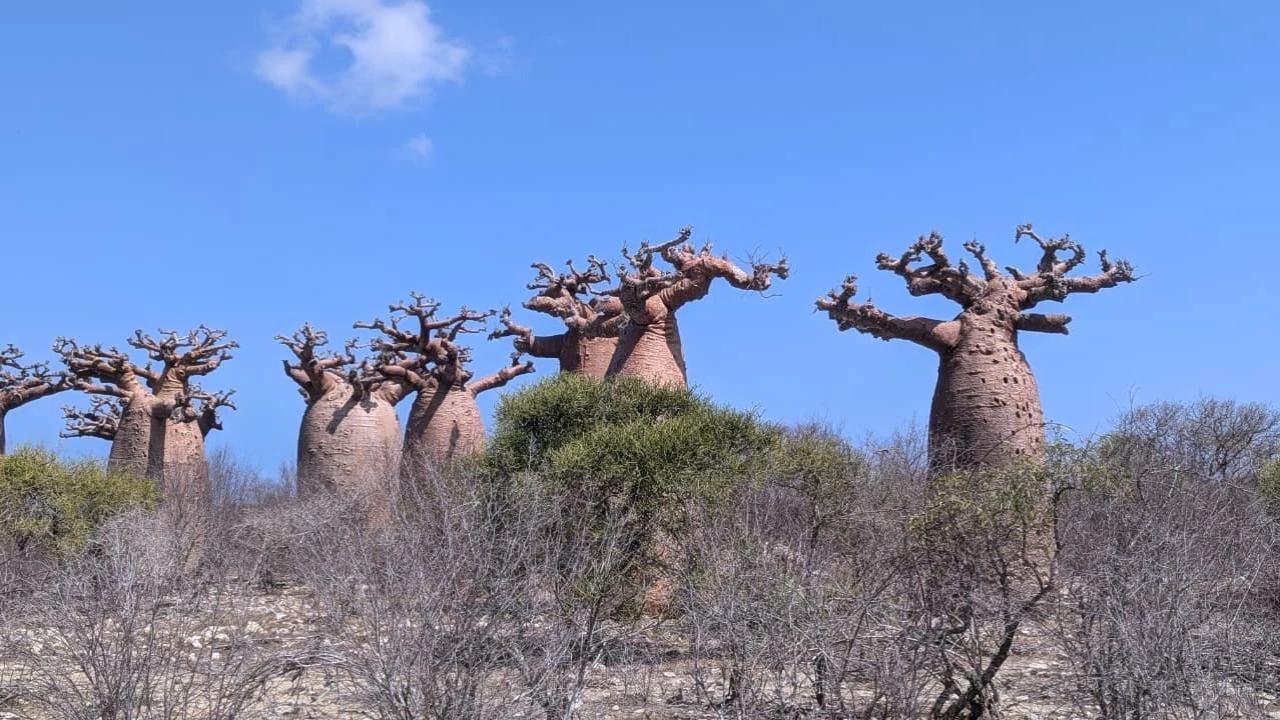
The spiny forest is the defining feature of Atsimo-Andrefana. It is a plant community where 95% of the species are endemic to the region itself. This is not a forest of broad leaves and high canopies, but a dense, often impenetrable thicket of xerophytic (drought-adapted) vegetation. The dominant plant family is the Didiereaceae, the octopus trees, which rise like thorny, tentacled specters. They are joined by bottle-trunked baobabs (Adansonia rubrostipa), Pachypodiums with their swollen, water-storing trunks, and a host of cactus-like euphorbias. Leaves are a liability here; most plants have reduced them to thorns, spines, or tiny, waxy leaflets, shifting photosynthesis to their green, succulent stems. This is a landscape armed against thirst. Along the coast, this thicket gives way to scrubland, vast dune systems, and saline flats fringing mangrove-lined lagoons and the immense barrier reef system offshore.
BIODIVERSITY SIGNATURE
In this harsh theater, life has produced some of its most extraordinary actors. The region’s endemism is not just high; it is absolute. This is a living laboratory of adaptive radiation. The signature species, the Verreaux’s sifaka, is a perfect emblem: a ghostly white lemur with a dark face, engineered for vertical clinging and leaping. To see them bounce, seemingly weightless, between the spined trunks of Didierea is to witness an evolutionary masterpiece. The forest floor is the domain of obscure tenrecs that have evolved to fill niches occupied by shrews, hedgehogs, and moles elsewhere. It is a world hotspot for chameleons, including the diminutive Brookesia species. Birdlife is equally specialized, with flagship endemics like the Long-tailed Ground Roller and the Subdesert Mesite, birds found only within this specific habitat. To conserve Atsimo-Andrefana is to safeguard not just species, but entire, unrepeatable evolutionary narratives. Its loss would represent an irrecoverable erasure from the global book of life.
THE HUMAN LANDSCAPE
The human story here is one of adaptation to scarcity. The interior is the homeland of the Mahafaly and Antandroy peoples, pastoralists whose lives are interwoven with their zebu cattle. Their presence is most strikingly marked by their tombs—elaborate, often monumental constructions decorated with carved wooden posts called aloalo, which narrate the life of the deceased. These are powerful works of funerary art that anchor family lineages to this arid soil. Along the coast are the Vezo, a semi-nomadic fishing people whose entire cultural and economic existence is tied to the sea. They navigate the Mozambique Channel in hand-carved pirogues with outriggers and square sails, their lives governed by the tides, the winds, and the health of the reef.
ACCESS & MOVEMENT LOGIC
Toliara is the region’s nexus. The paved RN7 highway terminates here after its long descent from the highlands, making it the logical conclusion to a classic overland journey. From Toliara, the RN9 heads north along the coast, though its condition varies dramatically. True exploration of the region’s interior, however, happens on a network of sandy tracks, or pistes, that are navigable only by 4×4 vehicles with experienced drivers. Movement is slow, dictated by the terrain and the seasons. Coastal travel can often be accomplished more efficiently by boat, following the traditional routes of the Vezo. This is not a landscape for casual, independent travel; it requires deliberate, well-planned logistical support.
AIR ACCESS STRATEGY
Toliara Airport (TLE) is the critical air hub for the entire southwest. Regular flights connect it to the capital, Antananarivo (TNR), providing the primary entry point for travelers not arriving overland via the RN7. It also serves as a strategic link for more complex itineraries, connecting to Fort Dauphin (FTU) in the southeast or Morondava (MOQ) to the north, allowing for multi-region circuits without the long overland return to the capital.
TRAVEL REALITY
Atsimo-Andrefana is a demanding environment. The heat is intense, especially from December to March. The landscape is dusty, the sun is punishing, and infrastructure outside of Toliara and a few coastal hubs is minimal. This is not a journey of conventional comforts. It is, however, one of profound rewards. The experience is one of immersion in a primeval landscape of staggering originality. The silence of the spiny forest, broken only by the chirping of insects and the call of a crested coua, is absolute. The sense of isolation and discovery is palpable.
KEY PARKS & PROTECTED LANDSCAPES
While formal national parks like Tsimanampesotse define the southern edge of this eco-region, the most accessible and representative landscapes are found in the community-managed and private reserves around Ifaty and the Ranobe spiny belt, north of Toliara. These areas protect superb tracts of intact spiny forest, offering guided walks to see the signature flora and fauna. The coastal zone includes the Ranobe lagoon and its barrier reef, a vital marine protected area offering excellent snorkeling and diving, as well as critical habitat for migratory waterbirds.
KEY EXPERIENCES & SIGNATURE MOMENTS
The core experience is a slow, guided walk through the spiny forest at dawn or dusk, when the heat subsides and the wildlife is most active. It’s a sensory immersion in the scent of dry earth and the strange architecture of the Didiereaceae. A trip by traditional pirogue across a lagoon to the barrier reef, watching Vezo fishermen manage their lines, provides a powerful cultural and ecological counterpoint. The signature moment, however, is witnessing a family of Verreaux’s sifakas moving through the forest—their balletic, ricocheting leaps an act of pure grace in a landscape of thorns.
Places like this are rarely visited — they are carefully reached. Through Vivy Travel Madagascar, a private journey into Atsimo-Andrefana can be seamlessly woven into a bespoke Madagascar itinerary.
Continue exploring Atsimo Andrefana: Arboretum d’Antsokay · Beza Mahafaly Special Reserve · Mikea National Park · Nosy Ve Androka National Park.
Looking to
explore Atsimo Andrefana?
If you're looking to book a trip, then get in touch. We would be delighted to plan your dream holiday.
Want expert
advice?
We're known for our first-hand knowledge of Atsimo Andrefana — we'd love to help you plan.
Contact usWant to explore
more?
Discover more of Madagascar in our Travel Intelligence library.
Browse the library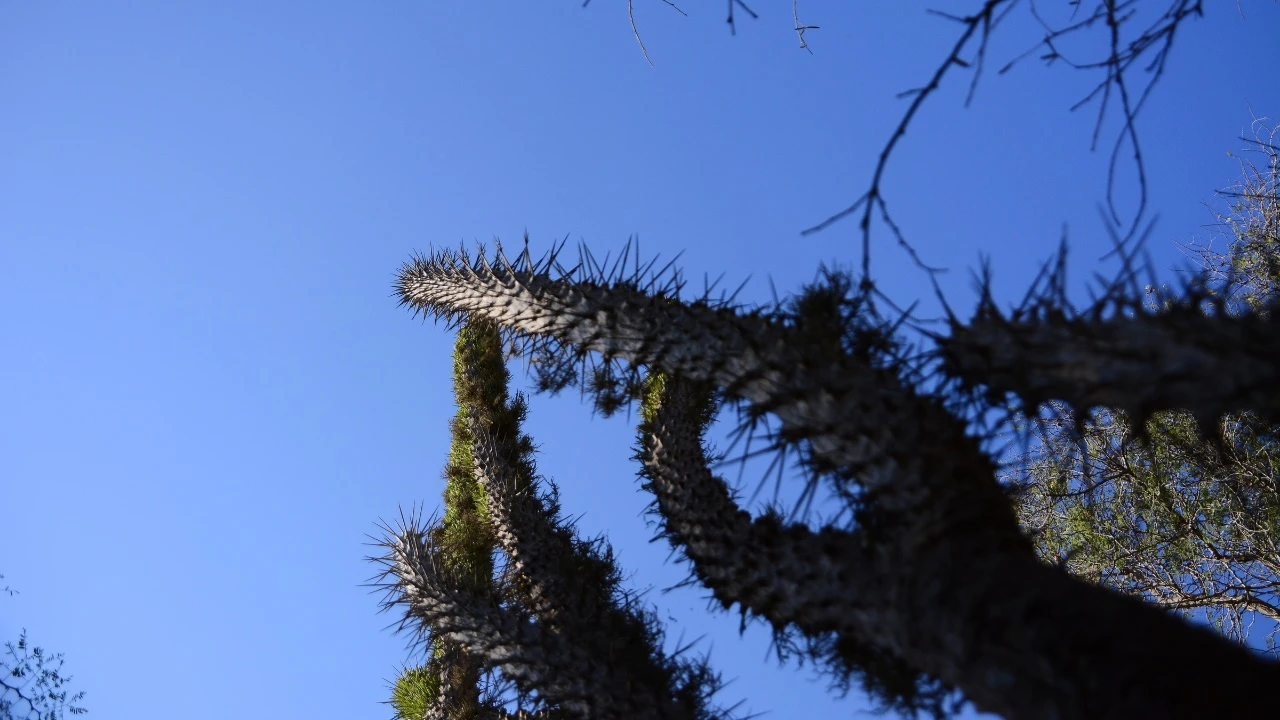
STRATEGIC TRAVEL LOGIC
A journey to Atsimo-Andrefana is an intellectual and philosophical undertaking. It is for the traveler who has seen the great rainforests and savannas of the world and now seeks a deeper, more challenging narrative. This region tells a story of evolution in extremis. It is a masterclass in biological design and resilience. For the conservation-literate traveler, it offers a frontline view of a globally unique biome under pressure, making a visit both an education and an act of witness. It is the perfect complement to the lush biodiversity of the eastern rainforests, showcasing the sheer ecological breadth of the Malagasy continent.
HOW THIS REGION CONNECTS YOUR JOURNEY
Atsimo-Andrefana is the classic terminus of the RN7 overland route from Antananarivo, the grand finale after the highlands and Isalo’s sandstone canyons. It serves as a self-contained module for a 4- to 6-day deep dive into the natural history of the south. From Toliara, air connections allow for a logical continuation to the northern coasts of Anjajavy or Nosy Be, or a return to the capital, creating a comprehensive circuit that covers Madagascar’s key ecological zones.
LIMITATIONS & OPERATIONAL CONSTRAINTS
The primary constraint is the climate; the austral summer (Dec–Mar) can be oppressively hot and humid, with a risk of cyclones disrupting travel. Road conditions on secondary routes are poor and can become impassable after rare, heavy rains. Water is a scarce resource, and conservation-minded consumption is essential. High-quality accommodation and guiding services are concentrated in specific nodes and must be secured well in advance.
WHY THIS REGION DEMANDS EXPERTISE
Navigating Atsimo-Andrefana requires more than a map; it requires deep local knowledge. An expert team is essential for managing the complex logistics of 4×4 travel on sandy pistes, gaining access to the best-preserved forest parcels (many of which are community-run), and engaging respectfully with the Mahafaly and Vezo cultures. Specialist naturalist guides are not a luxury but a necessity to decode the subtle complexities of the spiny forest, revealing the cryptic wildlife and explaining the astonishing plant adaptations that define this ecosystem.
PRACTICAL INTELLIGENCE
Region: Atsimo-Andrefana (Capital: Toliara)
Macro Zone: West–South
Region Type: Desert / mixed
Primary Ecosystems: Spiny forest, dry thicket, coastal plain
Signature Species: Verreaux’s sifaka (Propithecus verreauxi)
Endemism Level: Extreme
Key Parks: Ifaty-Ranobe spiny belt, Tsimanampesotse-like sites
Main Access: RN 9 (Toliara hub), local coastal tracks
Best Season: May–Nov (plages et forêts accessibles)
Ideal Duration: 4–6 days
Vivy Travel: Full regional immersion requires pre-arranged expert logistics, specialist naturalist guides, and multi-modal coordination.
EDITORIAL CLOSE
To journey through Atsimo-Andrefana is to recalibrate one’s understanding of life itself. It is a landscape that operates on a different set of rules, an architecture of thirst written in spine and thorn, baobab and sand. It presents an urgent, compelling argument for conservation, not of individual species, but of an entire, irreplaceable evolutionary theater. This is not a place you simply visit; it is a place you must decipher. And in doing so, you come away with a profound respect for the tenacity and sheer, improbable creativity of the natural world.
Madagascar’s Last Frontier
The deep south is Madagascar at its most raw. Our specialists handle every logistical detail.
+261 34 46 326 00