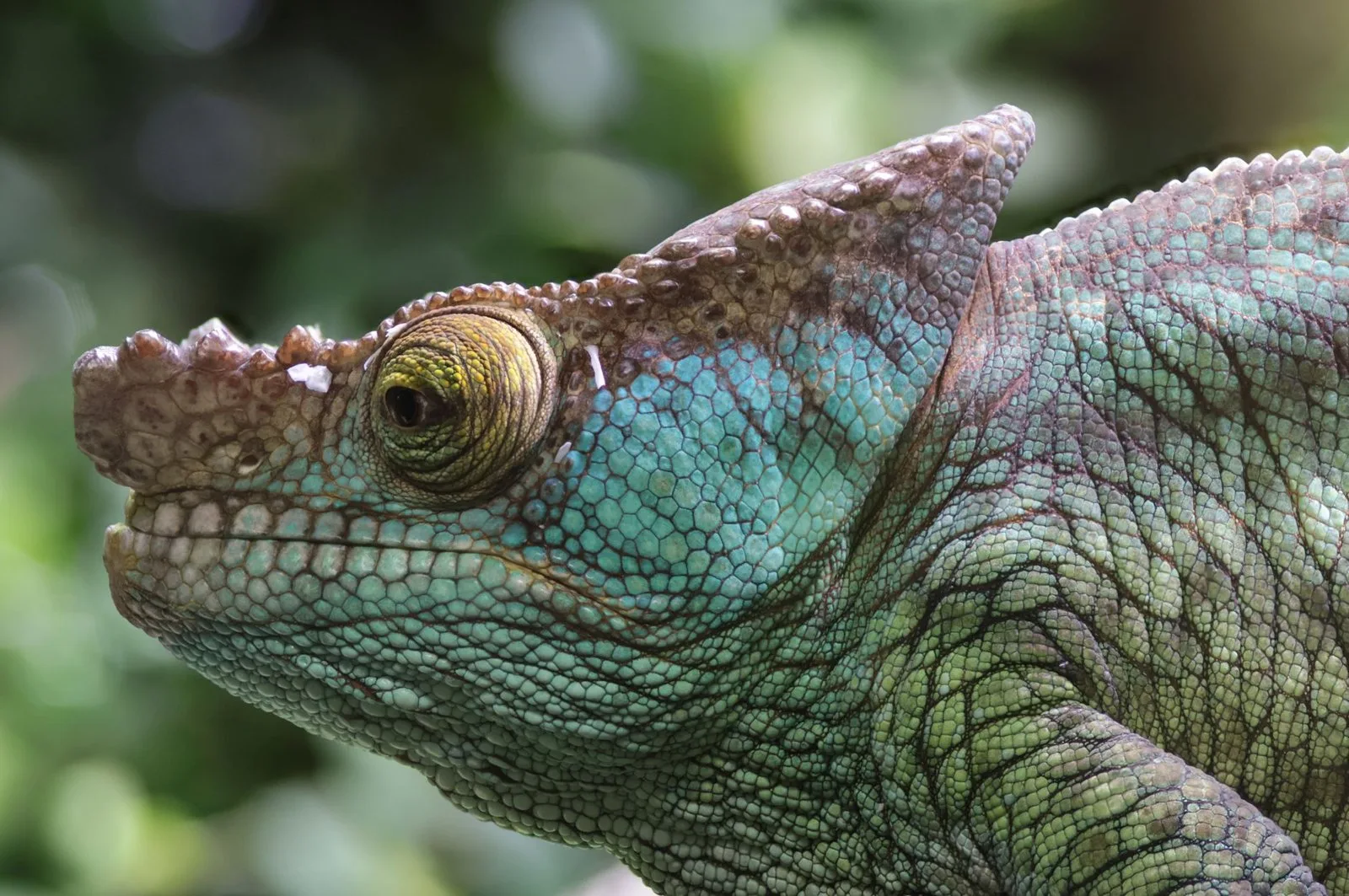
You are not looking at a piece of bark. You are looking at a lizard that has spent millions of years learning how to become one.
The first time a guide points out a leaf-tailed gecko, your perception of the forest shifts. What appeared to be a piece of dead foliage or a patch of lichen on a branch suddenly resolves into a living creature. Its body mimics the texture of decaying leaves, its tail flattened into a perfect replica. In that moment, you are not just seeing an animal; you are witnessing the end result of an evolutionary story that has unfolded in near-complete isolation.
To understand Madagascar’s reptiles is to understand deep time. The island broke away from the African continent some 160 million years ago, and its core—the ancient rock of the interior highlands—has remained above water while other parts of the landmass were submerged and reformed over eons. The primitive animals that found themselves on this drifting sanctuary were shielded from the competitive pressures that shaped life elsewhere. They were left to evolve on their own terms, resulting in a fauna that feels antique, governed by a different set of rules.
A World of Its Own
For herpetologists, Madagascar is less a country than a living laboratory. Over 850 species of reptiles and amphibians have been documented here, and the list grows continually as new discoveries are made. The numbers are a testament to the island’s role as an engine of speciation: approximately 98% of its terrestrial reptiles are endemic, found nowhere else on the planet. For frogs, that figure approaches 100%.
This is not the Africa you know. There are no vipers or cobras. Instead, you find boas whose closest relatives are in South America, evidence of an ancient oceanic dispersal. You find chameleons so small they can rest on the face of a coin, and frogs decorated with neon spots. Reptiles are adept colonizers of islands, their impermeable skin and ability to survive long periods without food giving them an advantage in crossing vast stretches of water. But once here, they radiated into forms seen nowhere else. A small number of founding frog families, for instance, diversified into an assembly of over 400 documented species, with estimates suggesting the true total could be closer to 750.
“More than 90% of Madagascar’s lizards are endemic. The island’s isolation is a catalyst for evolutionary divergence.”
The Art of Seeing
Traveling through Madagascar is an exercise in learning to see again. The forest floor is not just dirt and leaves; it is a mosaic where camouflaged life waits. A guide who has walked these trails for decades will stop, point to an unremarkable branch, and wait for your eyes to adjust. The reward is not just the sighting of a leaf-tailed gecko, but the understanding of how perfectly it belongs to its environment. This is a place where a small, red-bodied insect like the giraffe weevil carries a neck three times its body length for sparring, and where giant baobabs appear planted upside down against the sky.
Each creature, from the sucker-footed bat clinging to a palm frond to the smallest frog, is a chapter in this island’s long story. They are survivors of an ancient lineage, inhabitants of a world that charted its own course. To spend time here is to do more than observe wildlife; it is to read a biological narrative written in a language of scales, skin, and patient adaptation, a story that began when the continents themselves were arranged differently.
A Different Version of Life
Planning a journey to Madagascar is about preparing to see a world that evolved by its own rules.