
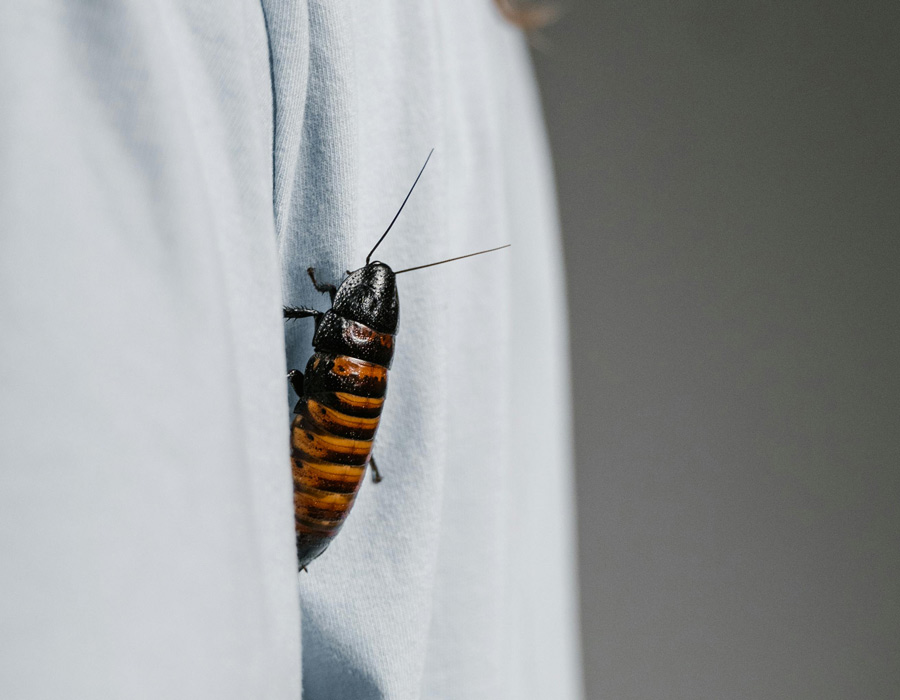
In Madagascar, the greatest revelations are often found not in the canopy, but on the forest floor, in the quiet details most travelers overlook.
Most journeys to Madagascar are framed by the silhouette of a lemur against the sunrise. It’s an iconic image, and for good reason. But for the traveler who has already seen the great migrations of the Serengeti or tracked gorillas in the Virungas, the island’s true exceptionalism lies deeper.
It’s found in the evolutionary narratives that play out in miniature, far from the crowds. Here, a creature as common as a cockroach tells a more complex story about survival than any apex predator. The Madagascar hissing cockroach, Gromphadorhina portentosa, is not an insect to be avoided. It is a key to understanding the pressures and compromises that define life on this isolated landmass.
A Lesson in Evolutionary Economics
The hiss of this insect, often mistaken for a simple defense mechanism, is a complex form of communication. It is used to intimidate rivals, attract a mate, or signal alarm. But the creature’s most compelling trait is invisible. Faced with finite resources, each male makes a silent, biological calculation: invest energy in growing large, combative horns to fight for dominance, or invest that same energy in developing larger testes to maximize reproductive success.
It is a stark trade-off between fight and fertility. This is not random; it is a dynamic strategy, a physiological response to the social environment. Observing this is to witness a negotiation with evolution in real time. It’s a subtle drama, but one that speaks volumes about the island’s unique ecological pressures. For those intrigued by the ‘why’ behind the wildlife, it is as compelling as any chase on the savanna. It’s one of many reasons Madagascar stands apart from mainland Africa.
From Theory to the Forest Floor
This is not an experience found in a zoo or a textbook. It happens every night in the damp leaf litter of Madagascar’s eastern rainforests. The most reliable place to encounter these creatures is in the protected reserves around Andasibe-Mantadia National Park, a manageable 3- to 4-hour drive east of Antananarivo.
The Night Walk:
The forest transforms after dark. The air cools, the diurnal species settle, and a new cast of characters emerges. This is when the real work begins. A private night walk with a naturalist guide is not about covering distance; it’s about calibration. Your guide, someone we’ve worked with for years, will bypass the well-trodden paths. They know which fallen logs are favored, how the humidity affects activity, and how to interpret the chorus of sounds. They will illuminate not just the cockroach, but the entire nocturnal ecosystem it inhabits—the tiny mouse lemurs, the camouflaged chameleons, the silent frogs.
Who This Is For:
This is an experience for the intellectually curious. The macro photographer seeking a subject with an extraordinary story. The family with older children, ready to move beyond passive wildlife viewing and engage with the science of adaptation. It’s for the traveler who understands that sometimes, the most memorable encounters are the ones measured in inches, not feet. An appreciation for these moments is a hallmark of a well-planned trip, and it reinforces why Madagascar rewards expertise.
“The hiss is not a sound of aggression. It’s the sound of a choice being made—a negotiation with evolution happening right at your feet.”
Building an Itinerary Around Detail
A focus on Madagascar’s micro-fauna does not mean sacrificing the iconic. Instead, it adds a layer of depth to your journey. An evening spent exploring the forest floor in Andasibe is the perfect counterpoint to a morning listening to the indri’s haunting calls from the canopy.
From Andasibe, the logic of an eastern rainforest circuit unfolds naturally. The journey can continue south along the RN7 to Ranomafana National Park, a biodiversity hotspot known for its twelve lemur species and rich herpetofauna. Here, further night walks can reveal entirely different species and ecosystems. The experience is about building a complete picture of the island’s life, from the smallest insect to the largest lemur. Deciding on the right combination of parks is the first step, and understanding which national parks belong on your Madagascar circuit is essential for a journey that flows with purpose.
PLAN YOUR JOURNEY INTO THE DETAILS
Some trips are about the view. Others are about what you find when you look closer.
For a closer look at this species, its hiss, and its ranked colonies, read our chronicle, Champions of Compromise.